Why walkers stop at Adrasan
The Lycian Way runs for about 540 kilometres along the Teke peninsula, from Ovacık near Fethiye to the hills above Antalya. It was waymarked in 1999 by Kate Clow and follows old mule tracks, Roman roads and the footpaths that used to link villages before there were roads. Adrasan falls in the eastern half, and it is one of the few places on this stretch where the trail meets a sandy bay with a shop, a pharmacy, a bus to the main road and a real choice of beds.
Most through-walkers arrive from the Karaöz direction in the afternoon, rest for a night or two, then climb out over the mountain to Olympos. Plenty of people skip the through-hike entirely and treat Adrasan as a base for day walks, which in warm months is the easier and far more sensible plan: you carry a day pack instead of a house, and you sleep in the same bed twice.
Stage 1 — Adrasan to Olympos over Musa Dağı
This is the classic. The path leaves the north end of Adrasan bay, climbs steadily through pine forest on the flank of Musa Dağı, crosses a saddle at roughly 700 metres and then drops through old terraces to the ruins and the beach at Olympos. Expect 12 to 17 kilometres depending on the variant you follow, and five to seven hours of walking with breaks.
The climb is relentless rather than technical: nothing to scramble, but little shade on the upper sections and no water source you can rely on. Carry at least two to three litres per person in warm weather, start at first light, and plan the return before you leave — there is no evening public transport from Olympos back to Adrasan, so a taxi or a lift has to be arranged in advance.
The reward is the saddle: the whole of Adrasan bay behind you, the Chimaera coast ahead, and on clear days the outline of Suluada sitting alone in the open sea. If you have the legs for it, the ruins of Olympos at the far end — a Lycian city swallowed by oleander and fig — are a strange and beautiful place to arrive on foot.
Stage 2 — Karaöz to the Cape Gelidonya lighthouse
Shorter, flatter and right on the water. From Karaöz, about a twenty-minute drive from Adrasan, the trail follows the coast south-east over rocky headlands to the lighthouse at Cape Gelidonya — Taşlık Burnu, the southernmost point of the Teke peninsula and one of the great sunsets of the Turkish Mediterranean.
Allow four to five hours each way for ten to twelve kilometres: the surface is stony and slow rather than steep. The lighthouse is still staffed and cannot always be entered, but the headland itself is the point. Five small islands — Beşadalar — lie off the cape, and this is the stretch of sea where the Bronze Age Gelidonya shipwreck was excavated in 1960, one of the first scientific underwater digs anywhere.
Most people walk it as an out-and-back from Karaöz. If you would rather not double the distance, arrange to be collected at the lighthouse road end and walk it one way.
When to walk, and when not to
March to May and September to November are the walking seasons. Spring brings wildflowers, running streams and green hillsides; autumn brings a warm sea, long light and empty trails. These are also the months when Adrasan itself is quiet.
July and August are genuinely dangerous on the exposed sections. Daytime temperatures regularly pass 35 °C, there is no shade on the Musa Dağı climb and no water on the way. If you are here in high summer, walk the first two hours after dawn and spend the rest of the day in the sea.
Winter walking works on the coastal stages — Karaöz to Gelidonya is fine on a clear January day — and the sea around Adrasan stays swimmable into late October, which is why many walkers put the Gelidonya section in the afternoon and swim afterwards.
What to carry
There are no shops, taps or cafés between the villages on either stage. Pack as if nothing will be available on the way, because nothing will be.
- 2–3 litres of water per person in warm months — the single thing people get wrong
- Boots or trail shoes with grip; polished limestone is slippery even when dry
- Sun hat, sunscreen and long sleeves for the exposed ridges
- An offline map on your phone — the waymarks are good, junctions still get missed
- Snacks, a basic first-aid kit, and a head torch if you start before dawn
Sleeping on the trail at Adrasan
Club Sun Village sits in forest on the Adrasan side of the bay, 1.8 km from the beach: 29 rooms in twin-villa wooden bungalows, a pool, a stone-arched restaurant and 8,000 m² of palm garden with no traffic in it.
For walkers the practical details matter more than the brochure ones. There is free parking if you drive in, a laundry, a safe in the room, a generator for power cuts, free Wi-Fi throughout, and luggage can be left at reception while you walk a stage with a day pack. Dinner is included in the Full Board Plus rate — à la carte, served in the evening — which, after seven hours on Musa Dağı, is the part people remember.
Pets are welcome, which matters if you walk with a dog. If you would rather not rent a car, a private transfer from Antalya airport (about 100 km, an hour and a half) can be arranged for €85.
Frequently asked questions
Does the Lycian Way actually pass through Adrasan?
Yes. Adrasan is on the eastern half of the route; the trail descends into the bay from the Karaöz direction and climbs out of it over Musa Dağı towards Olympos.
Can I walk Adrasan to Olympos in a day?
Yes, and most people do. Allow five to seven hours for 12–17 km, start early, and arrange your return transport before you set off — there is no evening bus from Olympos back to Adrasan.
Is the trail marked?
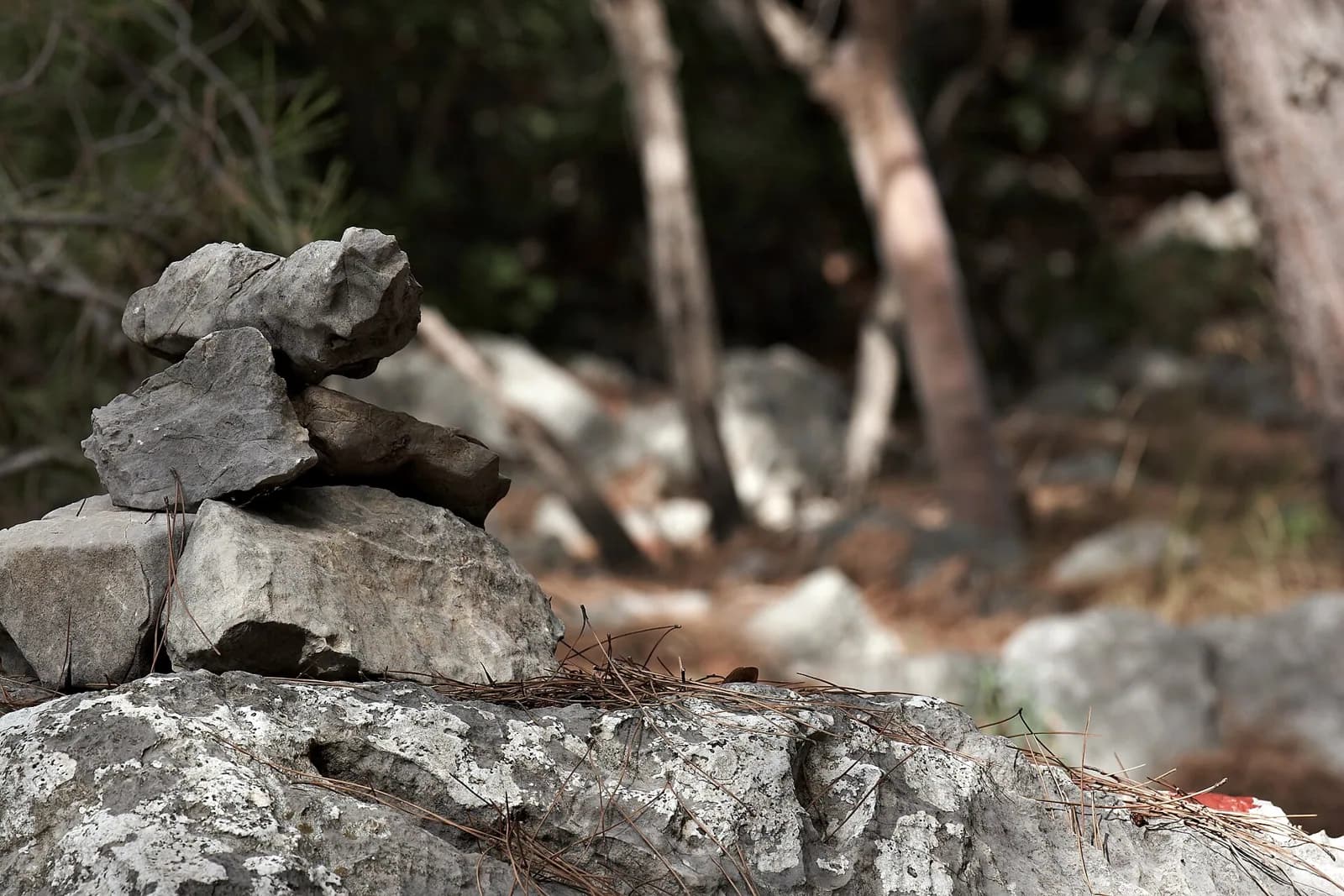
The Lycian Way uses red-and-white horizontal stripes painted on rocks and trees, the standard Grande Randonnée marking. They are generally reliable, but carry an offline map: junctions near villages and forest roads are where people lose the line.
Do I need a guide?
Not for these two stages if you have hiking experience and a map — both are day walks on marked paths. A guide is worth it if you are linking several stages, walking outside the main seasons, or travelling with a group of mixed ability.
Can you store luggage while I walk?
Yes, ask at reception. Many guests leave their main bag with us, walk the stage with a day pack and come back to the same room.
Is there water on the way?
Not reliably. Treat both stages as dry and carry what you will drink, two to three litres per person in warm weather.